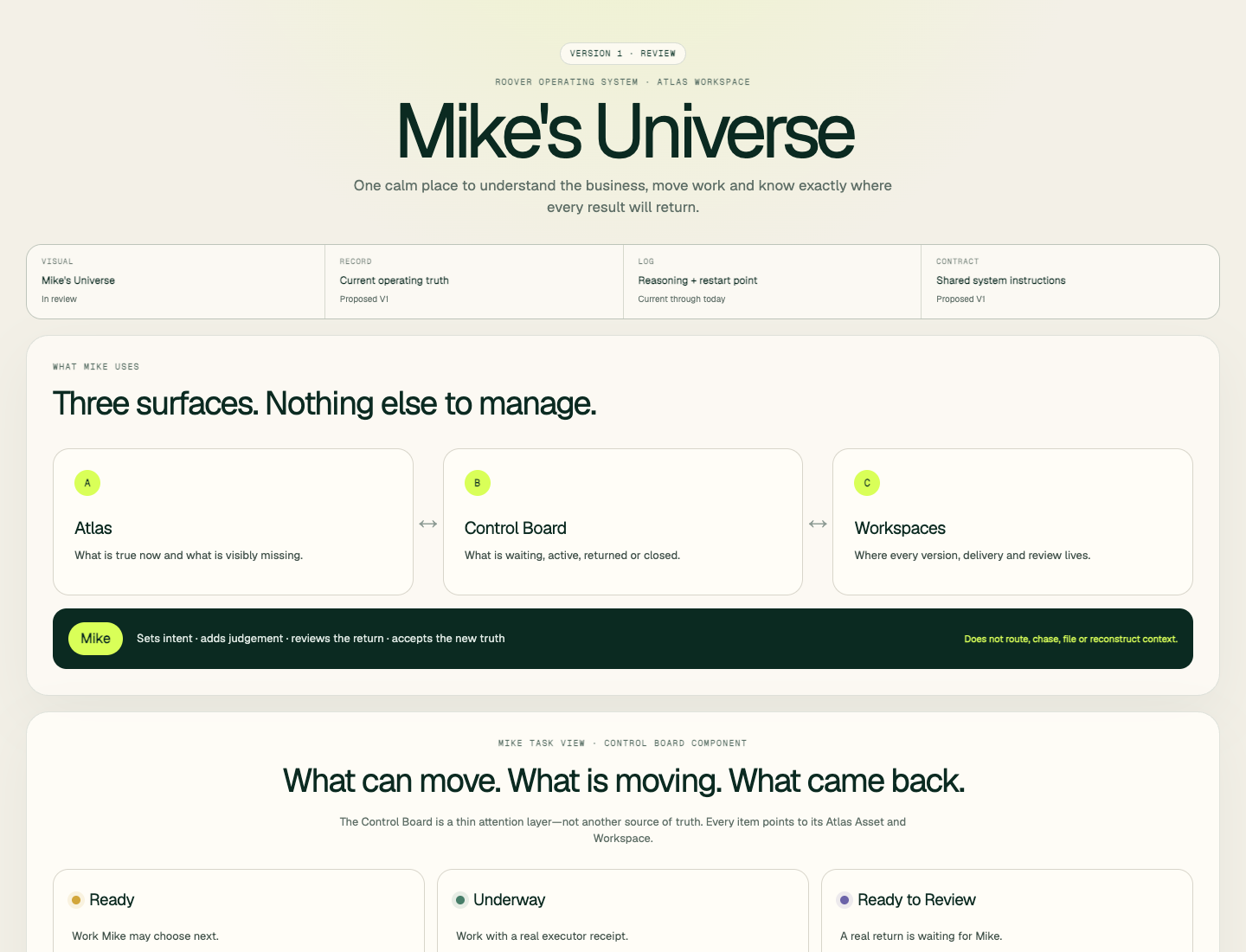
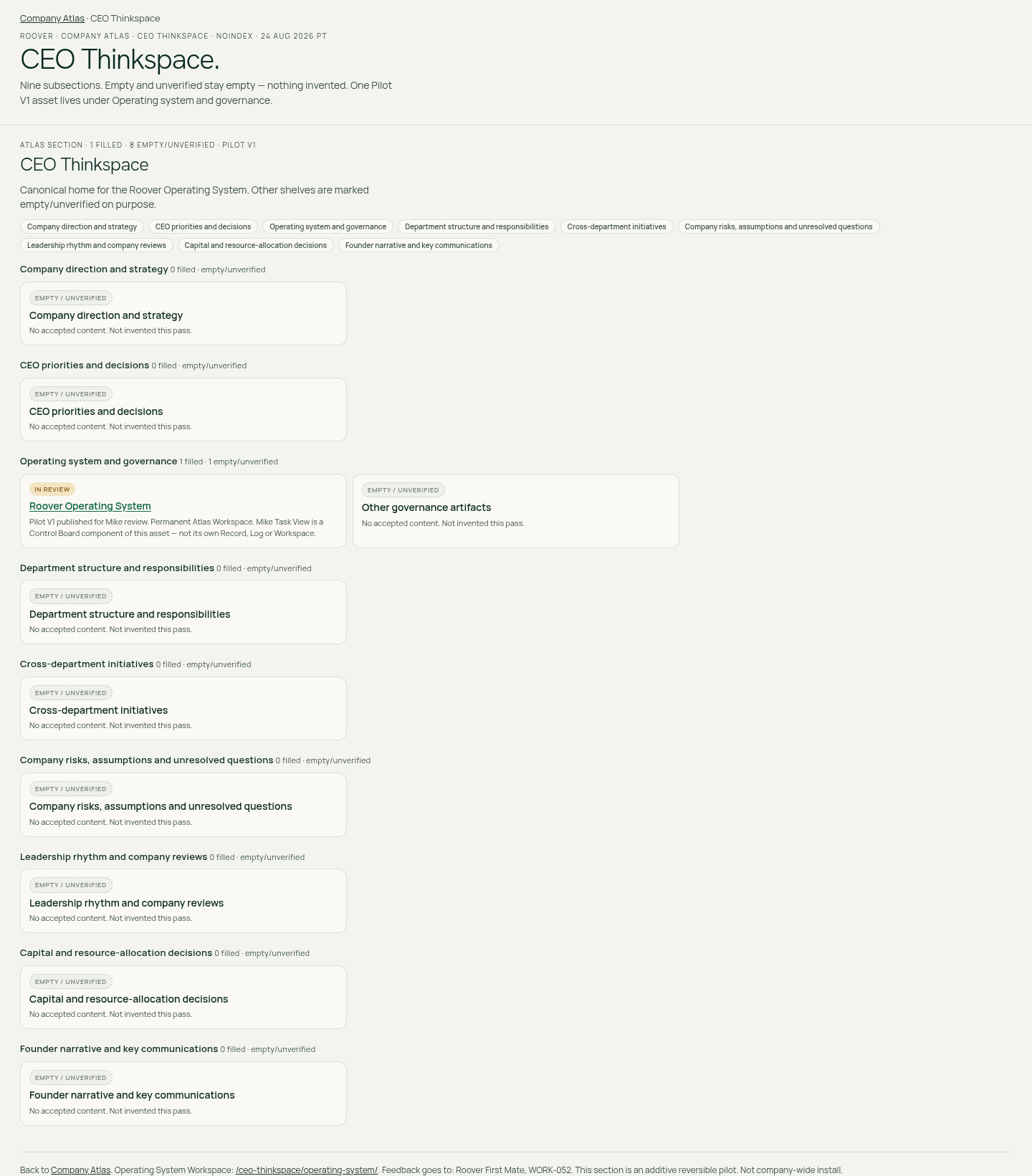
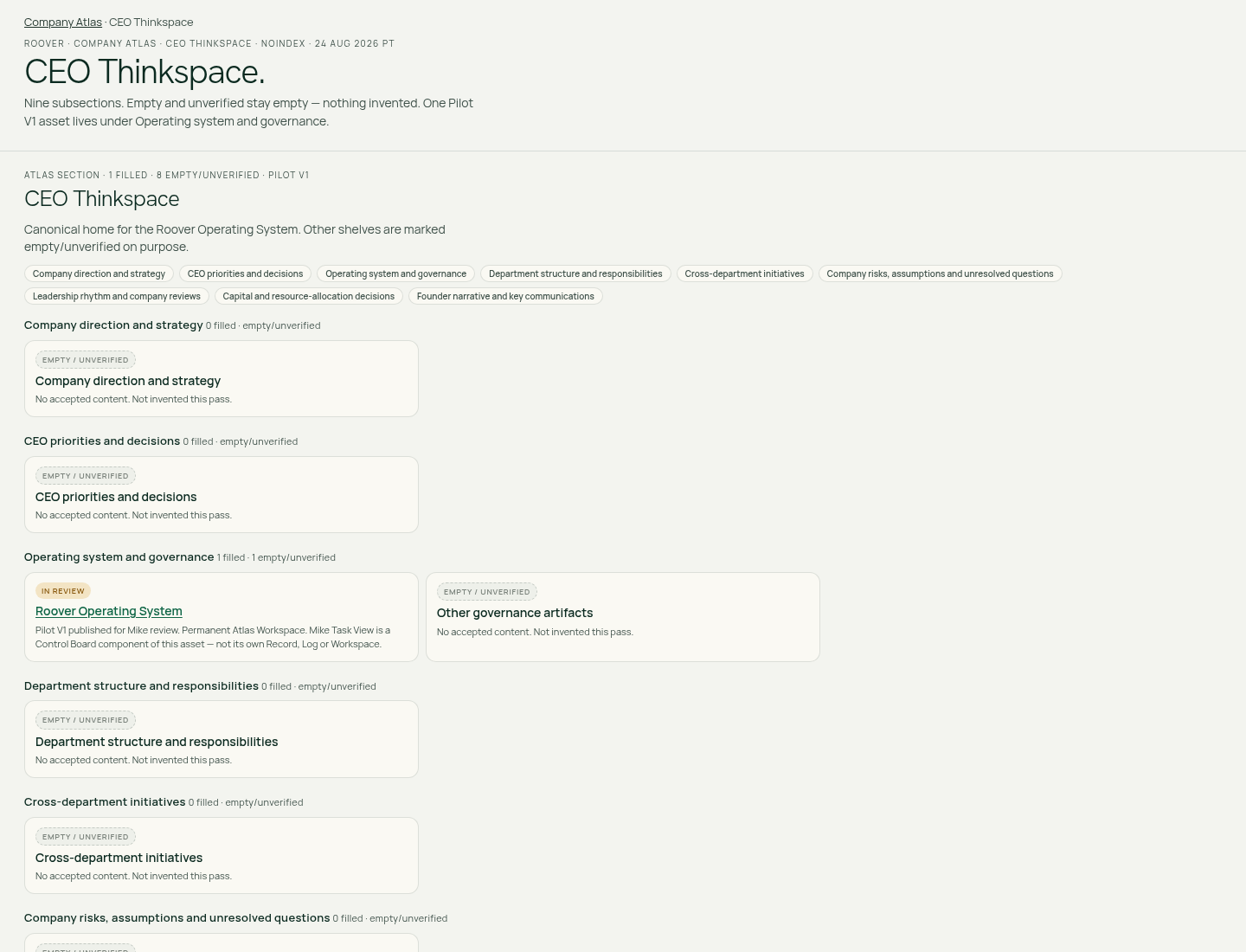
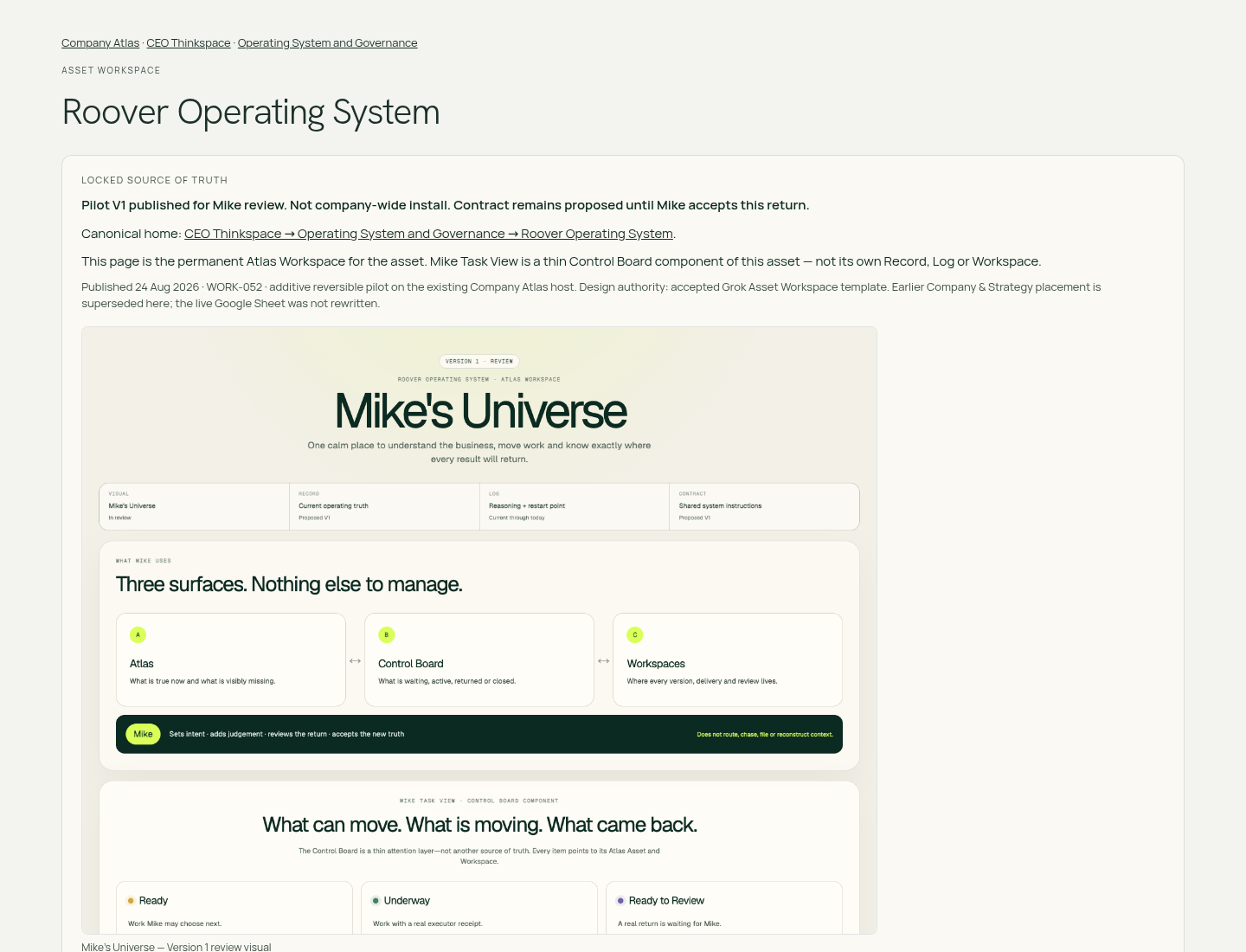
Prior continuation — V2 repair, ~4:04 PM PT
Full dated Log: ATLAS-LOG.md
Continued entry — 24 Aug 2026, after 3:32 PM PT — Thinkspace / CEO review of Pilot V1
This continuation is sourced from today’s Thinkspace / CEO review of the published Pilot V1 Workspace. It does not invent events. These beats were not in the box Log at V1 publish and must remain attached without flattening.
Guided review handoff requirement
A published Workspace is not reviewable by itself if Mike has to reconstruct what was delivered, what he is looking at, the current state, and the one next decision. The return must open with a guided review handoff — a one-screen Review Summary — so he can accept or name the exact change without hunting.
Notification gap is deferred to rollout
How Mike is notified that a return is waiting is a real gap. It is deferred to rollout. It is not a V1 or V2 acceptance gate. Do not build a notification system in this repair.
Codex must return a standard evidence package
Codex work is not delivered by a chat reply. Codex must return a standard evidence package to the asset Workspace: the result, a direct link, screenshots or appropriate evidence, a one-sentence change/context, and a factual Atlas Log entry. Without that package, the task is not Ready to Review.
Automation files routine returns
Routine returns are filed by automation into the same Workspace and Atlas Log. Filing the return is part of delivery, not an after-the-fact favour. The human or Head should not have to reconstruct where the result went.
Grok is an exception / quality layer rather than a costly mandatory second pass
Grok is not a mandatory second pass on every Codex return. Using Grok that way is costly and slow. Grok is an exception and quality layer: bounded last-mile change, visual proof, deployment, or a focused repair when the remaining work is genuinely small. Codex remains the substantial-build lane.
Thinkspace authorization boundary
CEO Thinkspace is a decision room, not an automatic execution surface. Conversation, questions, exploration, reactions, partial phrases and isolated words are not authorization to act. Previously approved work continues unchanged unless Mike explicitly names the work and the exact change he wants made. This boundary was already locked in the proposed Operating Contract (section 1A) and remains in force. The V1 “stop” at 3:28 PM PT was end-voice-chat, not cancellation.
This QA failure plus V2 repair
Pilot V1 was published at 3:32 PM PT. First Mate evidence screenshots were taken. The live V1 Workspace then failed QA as a review surface: no Review Summary; no Operating System Map as the primary visual; Mike’s Universe treated as primary and shown twice; evidence shots not inside the Workspace. ~4:04 PM PT 24 Aug 2026 — Mike explicitly authorized this bounded V2 repair of the existing Workspace only.
Restart point
Mike reviews the V2 Workspace URL; accept this Workspace + proposed OS model as current, or name the exact change. No Sheet/role rollout until then. Feedback goes to: Roover First Mate, WORK-052. HOLD for Mike.
Continued entry — 24 Aug 2026, ~4:10 PM PT — Workspace Return Standard authorized
Mike explicitly approved adding a Workspace Return Standard to this same V2 repair. No new Work ID. Scope not widened. The rule is proposed Contract section 8A and visible Workspace content on this page. The locked shared template file was not overwritten.
Every return states what Mike asked for, what was delivered, whether it is a test / approval candidate / accepted version, exactly what Mike should inspect or decide, the durable result link or file, what changed from the starting version, and what remains incomplete or uncertain. Evidence adapts to the deliverable. Localhost and local file links are never valid Mike delivery links. The permanent Workspace preserves the candidate, link, evidence, history and acceptance state.
Prior continuation — 24 Aug 2026, 3:00–3:32 PM PT — name lock, design authority, approval, resume
This continuation is sourced from the live WORK-052 thread the same afternoon. It does not invent events.
Name lock
The locked family of terms is:
Atlas / Atlas Record / Atlas Log / Atlas Workspace / Mike Task View / Mike’s Universe.
Do not say “visual task view” or “Mike View.”
Mike Task View is a thin Control Board component of the Roover Operating System asset. It is not its own Atlas Record, Atlas Log or Atlas Workspace.
Mike Task View modes
Mike’s two working modes remain:
- Choose & Start: Needs Setup / Ready to Start
- Review & Continue: Ready to Review / Underway
Design authority
The accepted Grok Asset Workspace template is design authority for this asset’s permanent Workspace.
The Codex file public/operating-system-workspace.html is content to steal into the Grok template only. It is not the published Workspace. A Codex Ready-to-Review presentation of that HTML was walked back.
Canonical home
The asset’s canonical home is:
CEO Thinkspace → Operating System and Governance → Roover Operating System
Earlier drafts that placed it under Company Atlas → Company & Strategy are superseded in this hosted Record/Log. The live Google Sheet was not rewritten.
Approval and resume
- 3:27:33 PM PT 24 Aug 2026 — Mike approved the bounded good-enough V1: an additive, reversible pilot on the existing Company Atlas host.
- 3:28 PM PT — voice-chat stop. That stop was end-voice-chat, not cancellation of this work.
- 3:32 PM PT — Mike said RESUME. Pilot publish proceeds. No new Work ID. Do not wait for any reviewer. Do not ask Mike.
Locked current truth after this return
Pilot V1 published for Mike review. Not company-wide install. Contract remains proposed until Mike accepts this return.
Restart point
This Workspace is the permanent review home. Feedback goes to: Roover First Mate, WORK-052. HOLD after publish. No broader rollout. Secretary files after return.
Full Atlas Log (earlier 24 Aug entries preserved)
Atlas Log — Roover Operating System / Mike’s Universe
Asset: Roover Operating System / Mike’s Universe Log date: 24 August 2026 Status: PILOT V1 PUBLISHED FOR MIKE REVIEW — 24 Aug 2026 3:32 PM PT. Contract remains proposed. Not company-wide install. Purpose of this entry: Preserve the reasoning, decisions, terminology, boundaries and exact restart point from today so that Mike, a Department Head, Codex, Grok or another capable system can pick this up without reconstructing the conversation.
Why this work exists
Mike reached a point where he could no longer tell, with confidence, what systems were genuinely operating, what work was actually underway, where the latest version of a deliverable lived, what context an executor had received, or where a completed result would return for review. Tasks had been discussed with rich context and then reduced to rows in a Google Sheet. Grok workers could act quickly, but could begin from the wrong source or insufficient context. Codex could perform substantial work, but finished work did not reliably return to Mike in a visible review surface. Department Heads were intended to preserve domain context but had not been proven to load and write back durable current truth consistently.
The emotional and operational consequence was that Mike felt he had surrendered control without receiving a trustworthy operating surface in return. The requirement is therefore not another invisible automation or another standalone management system. It is a simple, visible and portable operating model that makes the company’s truth, work and returns inspectable even when an individual AI, chat or automation fails.
The central design goal is:
Mike describes the outcome and supplies judgement. The system preserves the context, starts from verified truth, selects an appropriate executor, returns the result to one known place, and updates accepted company truth only after Mike approves it.
The problem discovered today
The previous implied flow was too close to:
Mike talks to a Department Head → a task is summarized into the Sheet → First Mate or Grok distributes the task → a worker tries to execute from the row.
That flow can destroy the value of Mike’s conversation. A Sheet row cannot safely carry a half-hour of reasoning, subtle constraints, the history of what has already been tried, the precise current file, the correct starting version, and the quality bar. A worker beginning from only that row may move quickly in the wrong direction.
The failure was not simply that Grok needed a better prompt. The responsibilities were misplaced:
- First Mate had been treated as though it could be a universal router, but it was not proven to choose between Codex and Grok, establish the canonical starting point, or recover full context.
- Department Heads were intended to hold context, but their durable read-before-work and write-back behaviour was not proven.
- The Google Sheet was carrying too much implied authority. It is useful for status and pointers, not for rich context or canonical files.
- “Underway” could be claimed without a real worker receipt tied to a verified version and destination.
- “Done” could mean that an executor replied in a chat, even when Mike had received no Workspace return.
- Cross-department work such as onboarding could be reconstructed separately by Product and Supply, creating drift.
- Accepted versions could be confused with newer experiments because a permanent immutable version history was not consistently visible.
The new model is designed specifically to remove those failure paths.
The locked mental model
The agreed family of terms is:
Atlas to see. Atlas Record to know. Atlas Log to remember. Atlas Workspace to change.
Atlas — to see
The Atlas is Mike’s visual company brain: the accepted current view of Roover, organized into departments and durable business assets. It shows what exists, what is currently accepted and what is visibly missing. It is the place where Mike can confidently invest in filling gaps because accepted work is preserved and findable.
The Atlas is not the work-in-progress surface and does not need to load every historical detail. Each relevant Atlas item points to its focused Workspace.
Atlas Record — to know
The Atlas Record is the written, portable source of accepted current truth. It explains what is current, where the authoritative sources live, what decisions and principles are in force, what an item means, and how it relates to the rest of Roover.
Existing Department foundation audits and “ground zero” work are intended to become Department Atlas Records. They must be recovered and verified rather than recreated automatically. Current evidence suggests this foundation work is uneven and often marked as awaiting its first end-to-end proof.
The Record is not a duplicate database containing every underlying transaction. Xero, Supabase, Drive, code repositories and other systems remain authoritative for their underlying records. The Atlas Record explains the current state, points to the authoritative source and preserves the accepted business meaning.
Atlas Log — to remember
The Atlas Log is the detailed, dated context and history for a durable asset or outcome. It preserves what Mike said and meant, the reasoning, corrections, decisions, unresolved questions, files and versions examined, what happened, why it happened, what returned, and the exact restart point.
The Atlas Log is not merely an executor prompt. An execution brief is derived from it, but the richer source context remains available so that important nuance is not destroyed by compression.
Every material conversation, decision, feedback cycle and returned iteration appends to the relevant asset’s Atlas Log. It does not record every click, keystroke or incidental remark. Immaterial conversation can remain in the chat. The threshold is whether the information would matter when resuming the asset, understanding a decision or executing the next change.
Atlas Workspace — to change
The Atlas Workspace is the permanent, focused visual home for one durable asset or outcome. It is a separate page but part of the same connected system. It loads only what is relevant to that asset, not the full Atlas.
The Workspace contains:
- What the asset or outcome is.
- The current accepted starting version.
- The latest returned version awaiting review, when one exists.
- Screenshots, direct links, files and evidence.
- A concise explanation of what changed.
- Mike’s feedback and the current next action.
- Previous immutable iterations underneath, newest first.
- Links to the relevant Atlas Record and Atlas Log.
- A simple route back to the asset’s place in the Atlas.
An accepted version is never edited in place. A new change creates the next iteration. “Current” is a pointer that moves only after Mike accepts the new version.
What gets a Workspace and Log
Not every sentence, chat or administrative action creates a new container. Every meaningful piece of work receives one routing decision:
- If it belongs to an existing durable asset or outcome, continue in that asset’s existing Workspace and Atlas Log.
- If it is a genuinely new enduring asset or outcome, create one new Workspace, Record reference and Atlas Log.
- If it is incidental and not materially important, leave it in the conversation and do not burden the system with it.
The Department Head makes that classification with Mike. The purpose is that everything important has one logical home without producing hundreds of disconnected workspaces.
The more precise hierarchy is:
Department = map. Asset = enduring truth. Task = the next change. Log = what happened. Workspace = what Mike reviews.
A new task does not automatically create a new Workspace. If the task is another change to the onboarding module, it belongs to the onboarding Workspace. If it creates a genuinely new enduring asset, that asset receives a new Workspace.
Department foundations and the visual Atlas now converge
Two streams of work had been happening in parallel:
- Department Heads were meant to audit the existing estate and establish their ground-zero foundations and sources of truth.
- Grok was helping break each department into visual categories and assets for the Atlas, such as logos, colours, landing pages, homeowner messaging and investor messaging for Brand.
Those streams are not competing systems. They are the written and visual sides of the same company foundation:
- Department audits become the written Atlas Records.
- The visual departmental inventories become the Atlas structure.
- Comparing the two shows what is missing, stale, unsupported or unverified on either side.
- When Mike chooses a missing or stale item to work on, the Department Head recovers the real starting version once and locks it into its Workspace.
- The same work that gets a real task moving also completes the company’s durable foundation.
This makes Mike’s context-setting a compounding investment. Once an asset is grounded, later tasks use the existing Record, Log and Workspace and add only the new delta. Mike should not be required to rebuild the same context again.
Shared assets across departments
Shared work has one canonical source, not a Product copy and a Supply copy.
For the roofer onboarding module, for example:
- There is one onboarding Atlas Record.
- There is one onboarding Atlas Log.
- There is one onboarding Atlas Workspace.
- There is one accountable Department Head for the outcome.
- Product and Supply both point to and read the same asset sources.
Other departments may contribute domain context, but they do not create competing versions. They should not have to talk to one another merely to discover the latest truth; they read the same durable asset context.
The task delivery loop
1. Mike and the Department Head shape the outcome
Mike talks naturally and gives the full reasoning, judgement and taste. The Department Head helps clarify what good looks like, recovers relevant existing evidence, finds the correct asset and verifies the current starting version.
Mike should only need to correct missing or wrong context after the Head has recovered what already exists. He should not be asked to repeat information that can be found in the Atlas Record, Atlas Log, Workspace, previous conversation, files or artifacts.
2. The Department Head creates the full context package
The context package contains:
- The verified starting version and exact files.
- The relevant Atlas Record.
- The full detailed Atlas Log context, including Mike’s original reasoning.
- A structured execution brief stating the requested outcome, constraints, quality bar, acceptance checks and what must not change.
- The permanent Workspace destination.
- Relevant screenshots, links and evidence.
The structured brief is the usable front page. It does not replace or destroy the richer source context.
The Google Sheet carries state and pointers to this package. The Sheet is never the full handoff.
3. The Department Head selects the execution lane
The Department Head owns the lane choice because it owns the outcome and context.
- Codex: substantial, context-heavy engineering or product builds where deep work and continuity matter.
- First Mate plus one Grok worker: bounded browser execution, deployment, visual prototypes, screenshot evidence and focused last-mile changes.
- Return to the Head: changes to architecture, product logic, the fundamental outcome or the quality bar require renewed thinking, not an automatic small-change worker.
First Mate may supervise approved Grok work. It must not reconstruct the task from a Sheet row, decide the canonical version or act as the universal router.
4. Start requires evidence
Before work begins, the executor must confirm:
- The asset identity.
- The exact locked starting version.
- The Atlas Record, Atlas Log and Workspace links.
- The permitted scope and stop conditions.
- The permanent return destination.
A real start receipt identifies the executor, the version and the destination. Without that receipt, the Board must not say Active.
5. The result returns to the same Workspace
Every result creates a new immutable Workspace iteration with the artifact, direct link, screenshots, evidence and a clear explanation of what changed.
Every returned iteration also appends a factual Atlas Log entry containing:
- What Mike requested.
- What the executor changed.
- Which locked version it began from.
- The new version, files, screenshots and links.
- What remains open.
- The timestamp and executor.
The executor supplies the factual return. The Department Head adds interpretation, decisions or restart context where needed.
An executor chat reply by itself is not delivery.
6. Mike reviews and accepts
The Board moves to Returned only when the new Workspace version and Log entry exist. Mike reviews the Workspace and either:
- Accepts the version, moving the current pointer and allowing accepted truth to be promoted into the Atlas Record and visual Atlas; or
- Gives feedback against the Workspace, creating the next bounded iteration or a renewed Head/Codex task depending on the nature of the change.
The Secretary preserves provenance and promotes accepted truth. It does not decide truth.
Using Grok for the final five or ten percent
Mike’s experience is that Grok is effective at quick, focused iteration and visibly gets bounded work done. Codex is still needed for substantial builds, but repeated small iterations in Codex have often been slow or difficult to close.
The intended pattern is:
- Codex returns the substantial build as a locked Workspace iteration.
- Mike reviews it in the Workspace.
- If the remaining change is genuinely bounded—such as a font colour, spacing adjustment, screenshot proof or deployment detail—the Department Head or Mike can ask First Mate to assign one Grok worker.
- The worker receives the exact locked version, relevant Record, Log, files, screenshots, scope and stop conditions.
- The worker returns the next iteration to the same Workspace and updates the Atlas Log.
Grok does not become the owner of company truth, and it does not silently alter an accepted version. It performs the bounded change within the context and return contract.
The longer-term Workspace may provide an obvious feedback input. The present MVP does not require that interaction to exist inside the page. Mike can initially give feedback in the relevant chat with the Workspace link, provided the system writes the feedback and return back to the Workspace and Log.
Workspace MVP and deliberate evolution
The accepted starting pattern is intentionally small:
- Latest returned version at the top.
- Clear state: starting point, active, returned, accepted or blocked.
- Screenshots and a direct link.
- Short explanation of what changed.
- Previous immutable iterations underneath.
- An obvious feedback destination.
The shared Workspace template should improve gradually through real use over the next month. Improvements should answer observed questions about what helps Mike review and move work faster. The first version should not be expanded immediately into a new comments system, backend, polling service, dashboard or automation suite.
The Workspace is a stable page whose presentation can improve without changing its identity, permanent URL or history.
Control Board and state rules
The Google Sheet remains Mike’s visible work-in-motion fail-safe. It stores task state, owner, executor and links to the Record, Log and Workspace. It does not store the full context.
The intended visible states are:
- Ready: context and sources are prepared, but no executor has proven a start.
- Active: a real executor receipt exists against the verified version and destination.
- Returned: the new Workspace iteration and Atlas Log entry exist for Mike’s review.
- Blocked: a real named gate prevents progress and the next required action is visible.
- Closed: Mike accepted the return and the accepted truth was promoted.
The hard fail-safes are:
- No Record, Log and Workspace links → not Ready.
- No verified starting version → do not start.
- No executor receipt → not Active.
- No Workspace return and Atlas Log entry → not delivered.
- No Mike acceptance → not current and not Closed.
- Ambiguous source, conflicting versions or missing context → stop and ask rather than guess.
Role boundaries
Mike
Mike sets intent, contributes judgement and taste, corrects missing context, reviews returns and accepts or redirects them. Mike should not route workers, chase chats, file evidence or reconstruct context.
Department Head
The Department Head is Mike’s thinking partner and outcome owner. It recovers context, maintains the relevant current continuity, verifies the starting point, prepares the context package, chooses the execution lane, remains responsible through return, and verifies write-back.
Codex
Codex performs substantial context-heavy builds. Its work is not considered delivered until the result has returned to the Workspace with evidence and the Atlas Log has been updated.
First Mate
First Mate is the Grok execution foreman. It supervises one bounded worker, requires the supplied asset context and source preflight, produces a real start receipt and ensures the worker returns evidence. It is not the company’s universal project router or context owner.
Grok worker
The Grok worker performs the bounded permitted change. It begins from the supplied exact version and sources, stops when context or authority is unclear, returns a new version and evidence, and writes the factual Atlas Log return.
Knowledge Secretary
The Secretary maintains provenance, filing and durable accepted truth after Mike’s acceptance. It does not infer acceptance, choose canonical product decisions or make stale work current.
Compatibility with what already exists
This design is intended to repair and rename existing structures rather than replace them with a competing system:
- Existing Department Brains and foundation audits map to Atlas Records and departmental continuity.
- Existing Company Atlas and department Atlas pages remain the visual Atlas.
- The accepted asset Workspace template remains the Workspace starting pattern.
- The existing Google Sheet remains the Control Board and task index.
- Existing First Mate and Grok execution capability remains the bounded execution lane.
- Existing Secretary filing remains the provenance and accepted-promotion lane.
Before claiming the operating contract is live, the existing instructions, routines and files must be checked for conflicts and labelled CURRENT, PARTIAL, UNPROVEN, CONFLICTING or RETIRED. Duplicate or premature structures must not become authoritative by accident.
Known references at the time of this log:
What is designed versus what is live
Designed and agreed in principle
- The Atlas / Record / Log / Workspace mental model.
- One canonical asset source for cross-department work.
- The context package as the execution handoff.
- The Sheet as index and state, not context.
- Immutable versions and Mike-controlled acceptance.
- Department Head ownership of context, lane choice and return.
- Codex for substantial builds and Grok for bounded execution or final refinement.
- Mandatory read-before-work and write-back-after-work behaviour.
- Visible evidence gates for Ready, Active, Returned and Closed.
Existing but uneven or partially proven
- Department foundation work and Department Brains.
- Company Atlas coverage across departments.
- Grok execution and visual return capability.
- Secretary filing and promotion paths.
- Control Board status and Work IDs.
Not yet installed or proven end to end
- A universal canonical link set for every active asset.
- Mandatory source/version/context preflight across every Head and executor.
- Mandatory Workspace and Atlas Log write-back as a completion gate.
- Reliable event-driven return from Codex into the Workspace.
- Consistent routing rules across every Department Head.
- A complete Mike’s Universe permanent page in Company Atlas (Pilot V1 Workspace now published; Mike review still required).
- Proven automatic synchronization between accepted Workspace versions, Atlas Records and the visual Atlas.
The architecture may be locked before these are live, but the system must not be described as operational until the real behaviour and receipts are proven.
Current implementation approach
The safest implementation sequence is:
- Mike reviews this Atlas Log and the Mike’s Universe visual and corrects any misunderstanding.
- Lock the operating vocabulary, role boundaries and fail-safe gates.
- Perform a compatibility crosswalk of current Atlas pages, Department foundations, Board rules, Head instructions, First Mate instructions, Workspace templates and Secretary routines.
- Reuse, rename and link existing structures; explicitly isolate duplicates or conflicting instructions.
- Apply the complete contract to one real priority asset rather than inventing a test project.
- Verify the full evidence chain: context package → canonical preflight → start receipt → execution → Workspace return → Atlas Log entry → Mike review → accepted promotion.
- Use the same proven contract for additional tasks while improving the common Workspace template gradually from actual use.
This sequence does not require Mike to stop doing real work for a giant migration. Grounding each priority asset once is itself useful task work and completes the durable foundation at the same time.
Exact restart point
Mike and the system are currently designing and reviewing the Roover Operating System as one enduring asset.
The immediate next step is not to claim the design is installed. The immediate next step is for Mike to review this Log and the Version 1 Mike’s Universe visual and answer:
- Does this faithfully preserve the reasoning and system agreed today?
- Is anything important missing, distorted or too compressed for another capable system to resume accurately?
- If accepted, should this become the starting Atlas Log entry and operating contract for the compatibility crosswalk and first real implementation?
No additional system should be created from this Log until Mike has reviewed it.
Continued entry — the Operating System Workspace becomes the anchor
Mike reviewed the first Atlas Log capture and confirmed that it was good and useful. The following additional reasoning is material and must remain attached to the asset.
This morning’s uncertainty is itself the ground-zero starting point for the Roover Operating System Atlas Workspace. Mike did not know what systems were genuinely operating, how the pieces tied together, where tasks and context lived, what Grok or Codex knew, or what he could safely trust. The work today turned that uncertainty into one durable asset with a visual, Record, Log, Workspace and shared Operating Contract.
The important operational change is that Mike can now return to the same asset tomorrow. If a real workday exposes a failure, the entire operating model does not need to be discarded. The accepted foundation and the reasoning behind it remain anchored. The next question becomes specific and manageable:
What exact connection failed, and what is the smallest logical change that can improve it without disturbing the rest of the accepted system?
That change becomes the next Workspace iteration. It is tested through real work, reviewed by Mike and either accepted into the current Operating Contract or rejected without damaging the prior version.
Mike should not be expected to trust an assistant’s reassurance that the system works. He should be able to trust what is visibly in front of him: the accepted visual, current Record, detailed Log, immutable Workspace versions, Board state and evidence receipts. When something is missing, the gap should be visible and local rather than hidden inside a claim that everything is underway.
The Operating System is a cross-company asset. Its canonical location is now:
Company Atlas → CEO Thinkspace → Operating System and Governance → Roover Operating System
Earlier drafts that placed it under Company & Strategy are superseded in this hosted Log. The live Google Sheet was not rewritten.
Mike’s Universe is Mike’s visual front door into that asset. The asset must not live in a private assistant area or depend on one AI vendor or one conversation.
The single Atlas Operating Contract is the shared instruction source for all Department Heads and execution roles. Common lifecycle, context, state and write-back rules are maintained once here. Individual Heads and workers contain only small role- or department-specific overlays and a mandatory pointer to the current Contract version. A system correction therefore creates one reviewed Contract iteration, not eleven separate manual rewrites that can drift.
This also changes how the system is proven. The proof should not be a detached test task with no context or canonical starting point. The Contract is applied to a real, grounded asset. Real work reveals a precise gap; the gap is corrected through the Operating System Workspace; the evidence chain proves whether that correction worked.
Updated restart point
Continue refining the Operating System as this one asset. Before installation, improve the first Log entry using the cold-read audit already completed: add a short checkpoint, extract settled truth into the Atlas Record, add permanent links and precedence rules, and remove accidental repetition. Then review the visual, Record, Log and first Operating Contract version together before applying the contract to live roles.
Continued entry — Atlas Log replaces manual Thinkspace note capture for grounded assets
Mike identified an important reduction in mental load: once a conversation is taking place inside a known Atlas asset and Workspace, Mike should not need to interrupt his thinking to ask that important points be copied into Thinkspace Notes. Material context belongs directly in that asset’s Atlas Log as the conversation develops.
This creates a clean boundary:
- Atlas Log: durable context, reasoning, decisions, feedback and restart points for a known asset or outcome.
- Thinkspace Notes: an inbox for important ideas or observations that do not yet have a clear asset home.
When an unassigned Thinkspace note is later attached to an asset, the material context is incorporated into that asset’s Log and the note becomes a pointer or is marked routed. It should not remain as a competing source of truth.
Mike should not have to trust that write-back happened. The operating contract must make it visible and enforceable:
- Material decision, feedback, task launch, executor return, topic handoff and session close are write-back checkpoints.
- The Workspace shows the latest Log checkpoint timestamp and restart point.
- A task cannot move to Ready, Returned or Closed if its required checkpoint is missing.
- The Department Head owns interpretive continuity; the executor owns its factual return; the Secretary owns accepted promotion.
This behaviour is designed and demonstrated manually in this Workspace, but it is not yet installed across all roles. Until installation is proven, the visible checkpoint is the evidence rather than an assumption.
Continued entry — 24 Aug 2026, 3:00–3:32 PM PT — name lock, design authority, approval, resume
This continuation is sourced from the live WORK-052 thread the same afternoon. It does not invent events.
Name lock
The locked family of terms is:
Atlas / Atlas Record / Atlas Log / Atlas Workspace / Mike Task View / Mike’s Universe.
Do not say “visual task view” or “Mike View.”
Mike Task View is a thin Control Board component of the Roover Operating System asset. It is not its own Atlas Record, Atlas Log or Atlas Workspace.
Mike Task View modes
Mike’s two working modes remain:
- Choose & Start: Needs Setup / Ready to Start
- Review & Continue: Ready to Review / Underway
Design authority
The accepted Grok Asset Workspace template is design authority for this asset’s permanent Workspace.
The Codex file public/operating-system-workspace.html is content to steal into the Grok template only. It is not the published Workspace. A Codex Ready-to-Review presentation of that HTML was walked back.
Canonical home
The asset’s canonical home is:
CEO Thinkspace → Operating System and Governance → Roover Operating System
Earlier drafts that placed it under Company Atlas → Company & Strategy are superseded in this hosted Record/Log. The live Google Sheet was not rewritten.
Approval and resume
- 3:27:33 PM PT 24 Aug 2026 — Mike approved the bounded good-enough V1: an additive, reversible pilot on the existing Company Atlas host.
- 3:28 PM PT — voice-chat stop. That stop was end-voice-chat, not cancellation of this work.
- 3:32 PM PT — Mike said RESUME. Pilot publish proceeds. No new Work ID. Do not wait for any reviewer. Do not ask Mike.
Locked current truth after this return
Pilot V1 published for Mike review. Not company-wide install. Contract remains proposed until Mike accepts this return.
Restart point
This Workspace is the permanent review home. Feedback goes to: Roover First Mate, WORK-052. HOLD after publish. No broader rollout. Secretary files after return.